Board report — Northbridge Health Partners
The numbers are computed in code, so they’re right. The narrative is assembled by a deterministic template that owns every figure — same input, same report, every run. Built for the moment a third party asks — the auditor, the insurer, the client: you’re not reconstructing evidence at midnight, you’re printing what’s already there. This is the actual AxiomLens deliverable, rendered from the wipeable sample client that ships in the box.
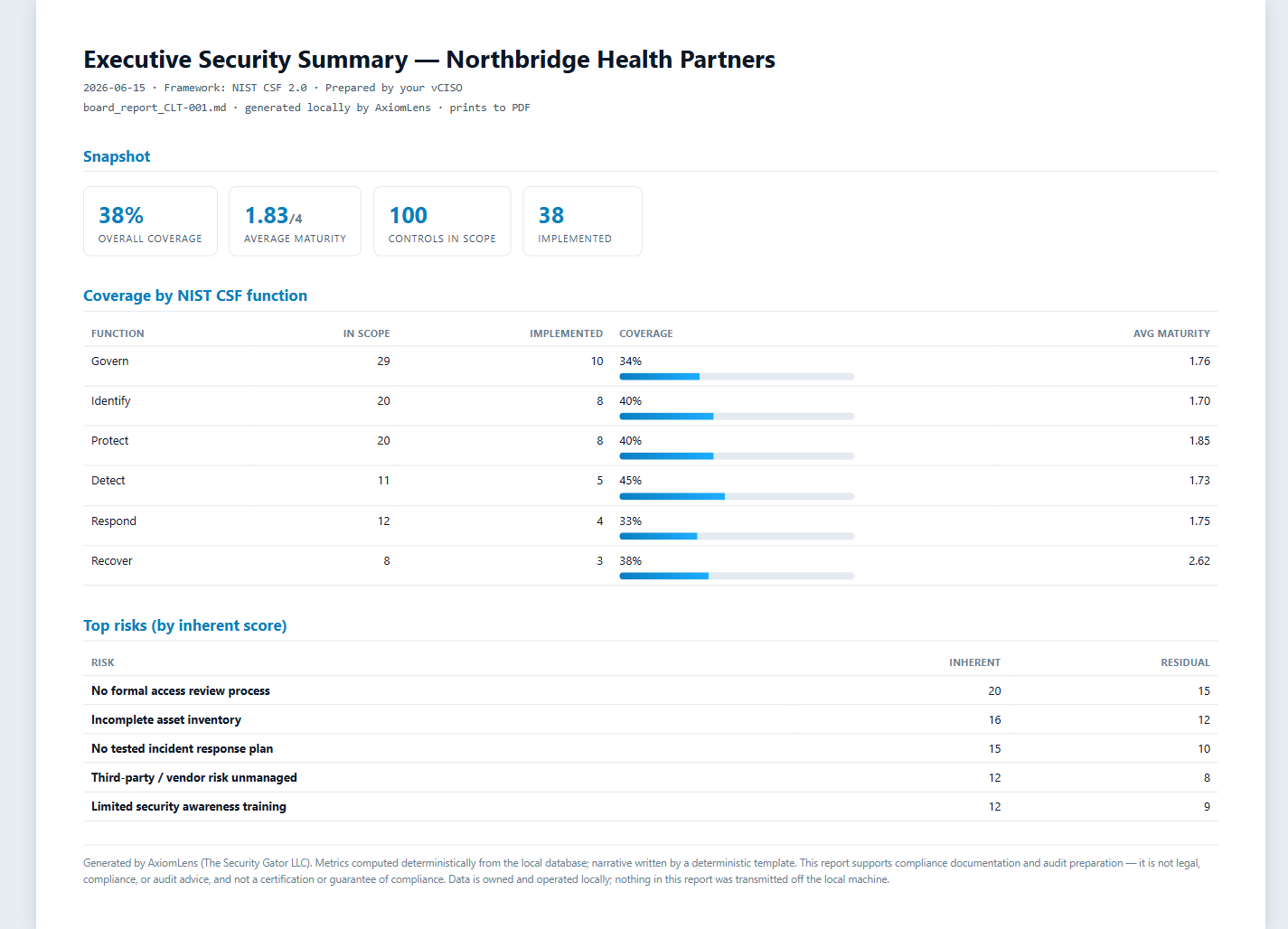
Coverage by NIST CSF function
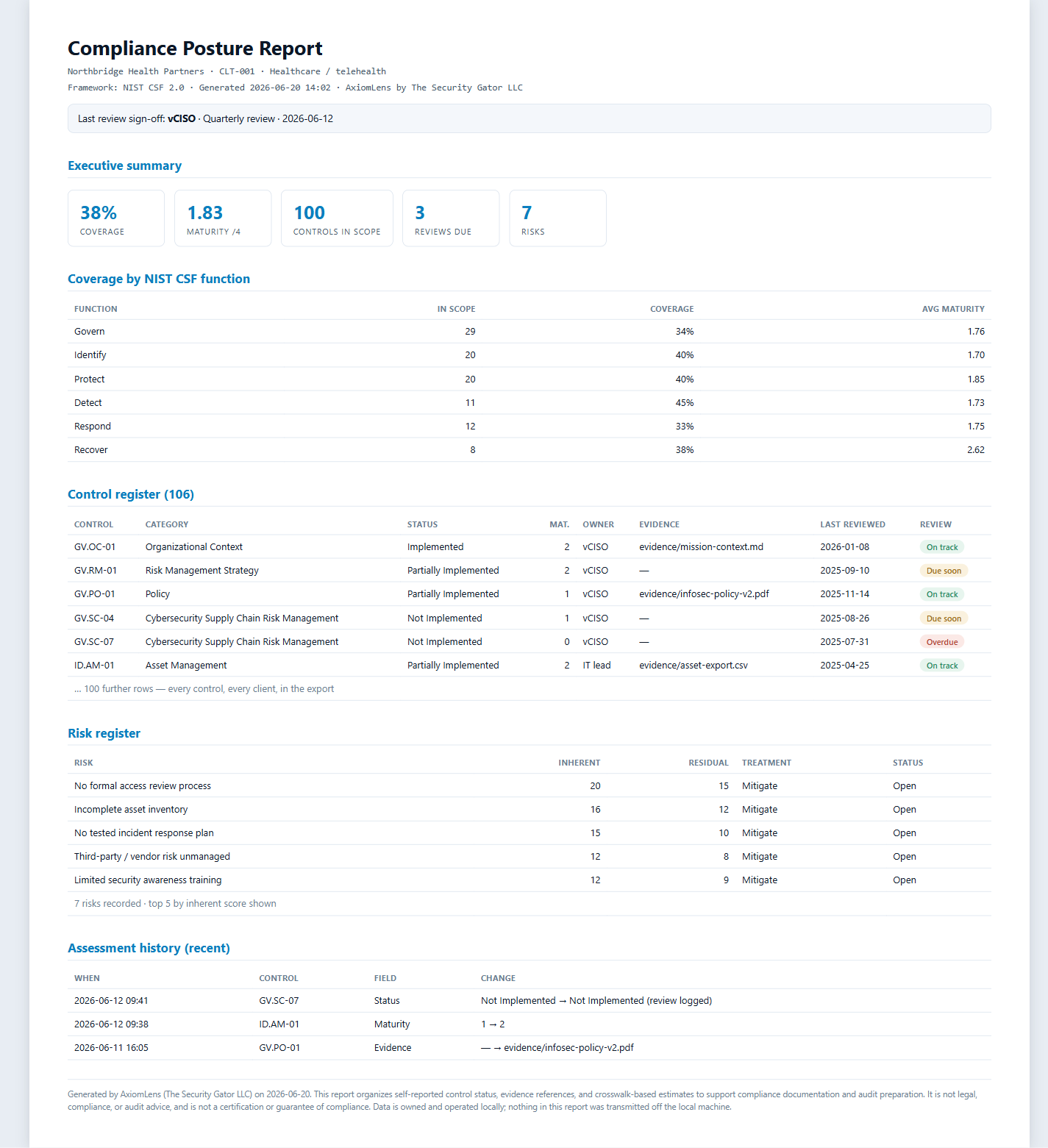
Coverage = implemented ÷ in-scope; program maturity is the in-scope-weighted average — the same formulas the engine runs. Nothing is faked.
| Function | Coverage | % | Implemented | Maturity |
|---|---|---|---|---|
| GV Govern | 34% | 10 / 29 | 1.76 / 4 | |
| ID Identify | 40% | 8 / 20 | 1.70 / 4 | |
| PR Protect | 40% | 8 / 20 | 1.85 / 4 | |
| DE Detect | 45% | 5 / 11 | 1.73 / 4 | |
| RS Respond | 33% | 4 / 12 | 1.75 / 4 | |
| RC Recover | 38% | 3 / 8 | 2.62 / 4 |
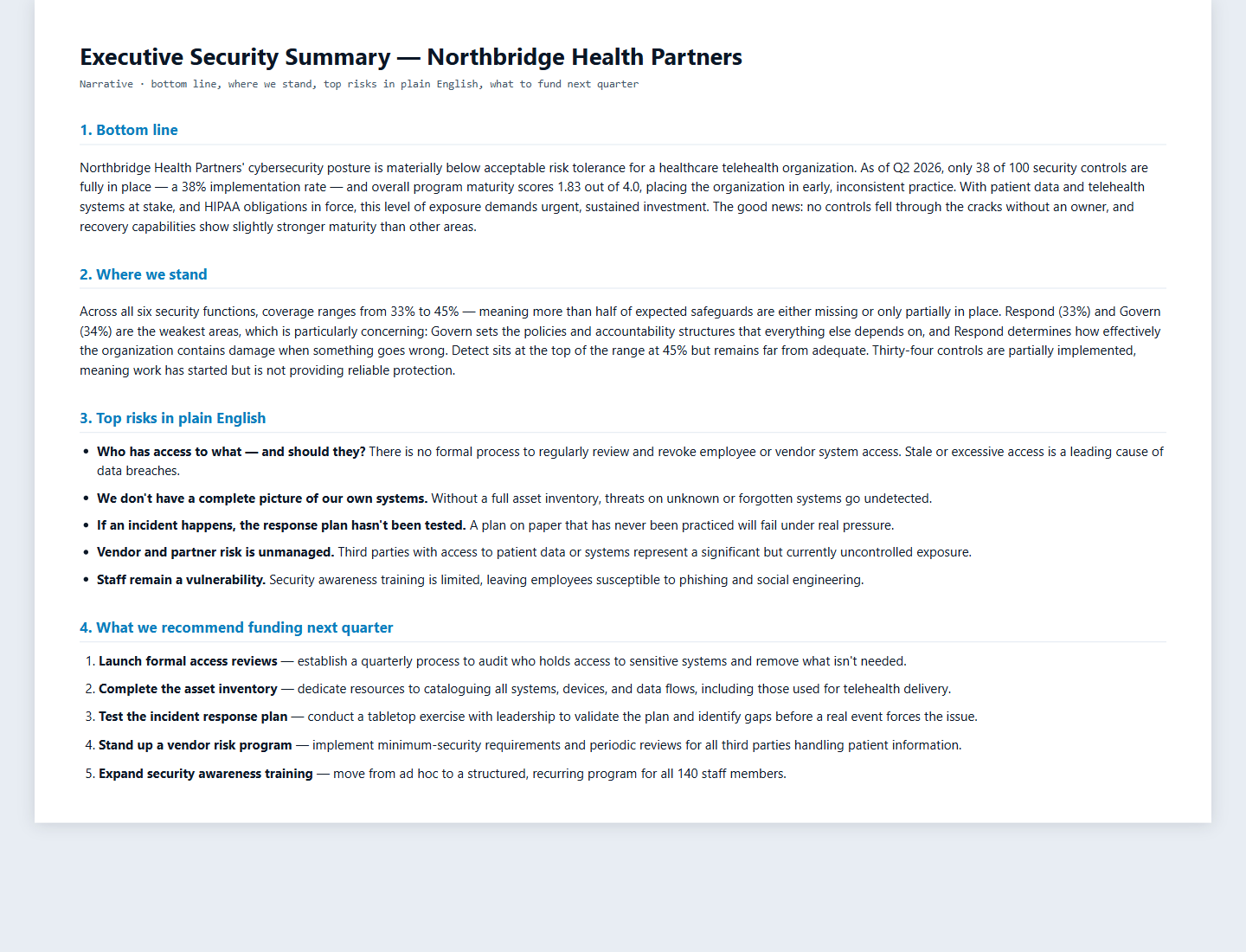
Northbridge’s posture is materially below acceptable risk tolerance for a healthcare telehealth organization. As of Q2 2026, only 38 of 100 controls are fully in place — placing the program in early, inconsistent practice.
The good news: no controls fell through the cracks without an owner, and recovery capabilities show slightly stronger maturity than other areas. The gaps are significant and spread across every function.
The two headline deliverables — both print to PDF
The Board Report translates posture for non-technical stakeholders — snapshot, coverage, risks, then a plain-English narrative and exactly what to fund next quarter. The Hand-Off bundles the full control register, risk register, sign-off trail, and history into one client-ready sheet. Every export is generated locally and opens print-ready — File → Print → PDF, hand it over. That’s the whole handover: no portal invites, no CSV wrangling, no evidence hunt the night before the audit.
 This report is one click in AxiomLens.
Explore AxiomLens →Buy on Gumroad
One email each Tuesday: the week’s threats that matter, one copy-paste hardening step, and the script to explain it to a non-technical stakeholder. Free, no pitch.